Research
TFM Quantitative Trading researches systematic trading ideas through a structured discovery process. The aim is not to guess where the market goes next, but to find repeatable conditions that are worth testing, challenging, and improving.
Research philosophy
Evidence before conviction
A trading idea is only useful if it can be expressed clearly enough to test. The research process begins with measurable conditions, repeatable rules, and results that can be inspected without relying on a story.
Robustness over excitement
Attractive backtests are easy to produce and easy to misread. TFM gives more weight to stability, implementation realism, costs, risk constraints, and how an idea behaves outside the data that found it.
The central question
The question is not "can this look profitable in a backtest?" The harder question is "does this pattern still make sense after we try to break it?"
TFM research framework: Tomatoes From Mars®
Markets are noisy
Tick data contains a huge number of possible patterns, most of which are random, temporary, or too fragile to trade. The challenge is to search that space without turning the search itself into overfitting.
Ideas need structure
Tomatoes From Mars® turns raw observations into comparable research candidates. It keeps the workflow explicit: what was tested, under which conditions, with which assumptions, and what happened next.
Workflow
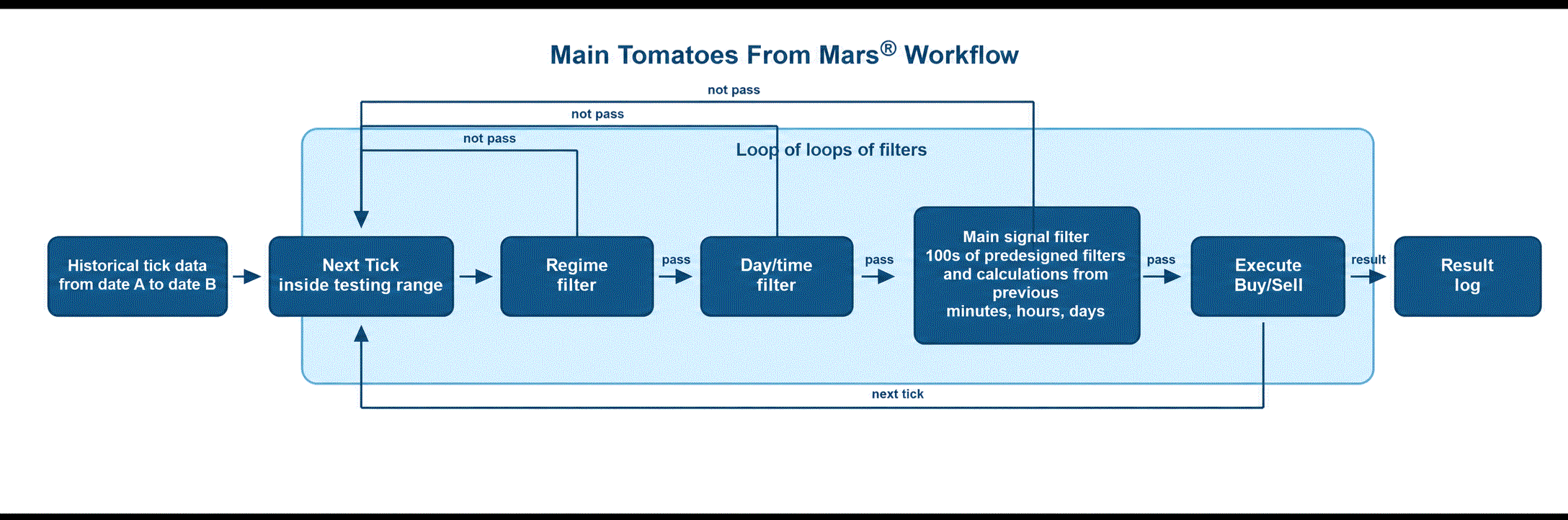
The framework scans historical data through a repeated filter-and-test loop. It is designed to discover seeds for further research, not to declare a finished trading system.
How our framework works
1. Define the test range
The process starts by choosing the historical window, instruments, session boundaries, and data resolution used for the scan.
2. Apply regime filters
Market behaviour can change across volatility, trend, liquidity, and time-of-day conditions. Regime filters help separate different environments before testing the signal itself.
3. Apply timing filters
Many intraday effects are sensitive to when they occur. Tomatoes From Mars® can isolate periods such as opens, closes, sessions, or specific time windows.
4. Test the signal idea
The main signal filter represents the condition being studied: price movement, candle behaviour, momentum, volatility, distance from levels, or other measurable market states.
5. Simulate execution
A signal only matters if it can be translated into orders. The framework includes execution assumptions so research is closer to the conditions a real system would face.
6. Log and compare results
Results are logged consistently so candidates can be compared, reviewed, and filtered for deeper validation. The output is a ranked research queue, not a final answer.
What counts as a seed
A seed is a promising condition
A seed is an early pattern that appears interesting enough to investigate. It may be a timing effect, a regime-dependent signal, a recurring price behaviour, or a combination of filters that produces unusual results.
A seed is not proof
The fact that a condition worked in a scan does not make it tradable. It may be noise, data-mined, too sensitive to costs, or dependent on a market environment that may not repeat.
What makes a seed worth studying
- The logic is simple enough to explain and repeat.
- The result is not concentrated in only a handful of trades.
- The behaviour survives reasonable changes in parameters.
- The effect still looks plausible after costs and execution assumptions.
- The result has a reason to exist beyond the chart looking attractive.
Validation after discovery
Out-of-sample testing
A candidate must be tested on data that was not used to find it. This helps separate genuine structure from patterns that were fitted to one historical window.
Parameter sensitivity
Robust ideas should not collapse when thresholds, time windows, or market filters are adjusted within reasonable ranges.
Cost and slippage review
Many signals disappear once spread, commission, latency, partial fills, and realistic execution constraints are included.
Risk behaviour
The distribution of wins, losses, drawdowns, exposure, and tail events matters as much as headline return.
Market dependence
A candidate is reviewed across different periods and conditions to understand when it works, when it fails, and whether those failures are acceptable.
Operational fit
A research result must fit the practical limits of data quality, broker execution, monitoring, capital allocation, and system reliability.
What our research framework is not
Not a prediction machine
Tomatoes From Mars® does not claim to predict markets. It identifies historical conditions that may deserve further testing under strict assumptions.
Not a guarantee of profitability
No discovery framework can remove uncertainty. The value is in making the research process more disciplined, transparent, and repeatable.
Not a replacement for risk management
A signal can be statistically interesting and still be unusable if the risk profile, capacity, or execution behaviour is poor.
Not an investment product
TFM uses research for proprietary trading with the company's own capital. The material on this page is informational and describes a research process.
Research outputs
Candidate library
- Signal definitions
- Regime and timing filters
- Execution assumptions
- Result summaries
Validation notes
- Out-of-sample behaviour
- Parameter stability
- Cost sensitivity
- Failure conditions
Implementation queue
- Ideas for deeper modelling
- Ideas rejected for fragility
- Ideas needing better data
- Ideas ready for prototype work